
What total cost of ownership (TCO) means for fleet dashcam investments
Total cost of ownership (TCO) for fleet dashcams is the full financial impact of deploying, operating, and maintaining a video-based safety system over its lifecycle, offset by measurable cost reductions and risk mitigation.
TCO is not limited to purchase price. It includes ongoing operational expenses, indirect costs, and the financial value of avoided losses. In a fleet environment, this extends beyond equipment into insurance exposure, driver behavior, and incident frequency.
A complete TCO model captures both sides of the equation:
- Total costs incurred over time
- Total costs avoided or reduced through deployment
This dual perspective is essential because dashcams operate as a cost-control mechanism rather than a passive asset. Fleets that treat them as a simple hardware purchase consistently underestimate their financial impact.
The core TCO formula applied to fleet dashcams
TCO for fleet dashcams is calculated by subtracting total cost savings from total lifecycle costs over a defined time period.
A practical working formula:
TCO = (Acquisition + Implementation + Operating + Maintenance Costs) – (Risk Reduction + Efficiency Gains + Avoided Losses)
Each component must be quantified across a consistent timeframe, typically 3–5 years for fleet technology.
Key cost categories in the formula
- Acquisition costs
- Hardware purchase per vehicle
- Installation labor
- Peripheral equipment (mounts, sensors, wiring)
Dashcam pricing varies widely depending on capability, ranging from under $100 for basic models to $500+ or significantly more for advanced systems with AI and telematics integration.
- Implementation costs
- Fleet rollout coordination
- Training for drivers and managers
- Policy development and compliance setup
- Operating costs
- Cloud storage subscriptions
- Cellular data usage
- Software licensing
- System monitoring
- Maintenance and lifecycle costs
- Hardware replacement cycles
- Warranty gaps
- Technical support
These categories establish the baseline cost side of the TCO equation.
Why dashcams fundamentally change fleet cost structures
Dashcams reduce high-variance costs that typically dominate fleet financial performance, particularly accident-related expenses, insurance claims, and operational inefficiencies.
The most significant financial impact does not come from marginal savings. It comes from controlling unpredictable, high-cost events.
Examples of cost volatility affected by dashcams:
- Collision-related repairs and downtime
- Legal and liability exposure
- Insurance premium fluctuations
- Fraudulent or disputed claims
Accident-related costs alone can reach tens of thousands to hundreds of thousands per incident depending on severity . Even small reductions in incident frequency materially change total fleet economics.
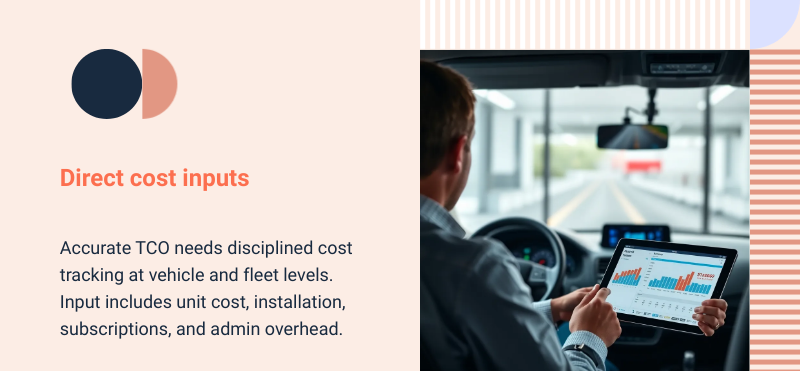
Direct cost inputs required to calculate dashcam TCO
Accurate TCO modeling requires disciplined cost tracking at the vehicle and fleet level.
Required cost inputs
- Cost per dashcam unit
- Installation cost per vehicle
- Monthly subscription per vehicle
- Annual maintenance/replacement rate
- Data usage cost per vehicle
- Administrative overhead (time spent managing footage, compliance, etc.)
Example baseline calculation (per vehicle)
| Cost Component | Annual Value |
| Hardware amortization | $120–$300 |
| Installation (amortized) | $50–$100 |
| Subscription & data | $180–$600 |
| Maintenance | $50–$150 |
| Total Annual Cost | $400–$1,150 |
This establishes the cost foundation before accounting for savings.
Risk reduction is the largest financial driver in dashcam TCO
Risk reduction is the most financially significant variable in the TCO equation because it directly affects catastrophic and unpredictable costs.
Dashcams reduce risk through three mechanisms:
- Behavioral correction
Drivers operate more cautiously when monitored. - Event documentation
Video evidence accelerates claim resolution and prevents false liability. - Proactive intervention
AI-enabled systems identify risky behaviors before incidents occur.
Fleets using dashcams report measurable reductions in accidents, claims, and insurance costs. Some deployments show accident reductions and claim cost improvements significant enough to materially shift annual budgets .
Insurance impact and how to quantify it in TCO
Insurance cost reduction is one of the most quantifiable benefits in a dashcam TCO model.
How dashcams influence insurance economics
- Reduced claim frequency
- Faster claim resolution
- Lower litigation exposure
- Improved insurer risk profile
Many insurers offer discounts or incentives for fleets using dashcams, often in the range of 5–20% on premiums.
How to calculate insurance savings
Insurance Savings = (Baseline Premium – Adjusted Premium with Dashcams)
Example:
- Baseline annual premium per vehicle: $5,000
- Discount: 10%
- Annual savings per vehicle: $500
This single variable often offsets a large portion of total dashcam operating costs.
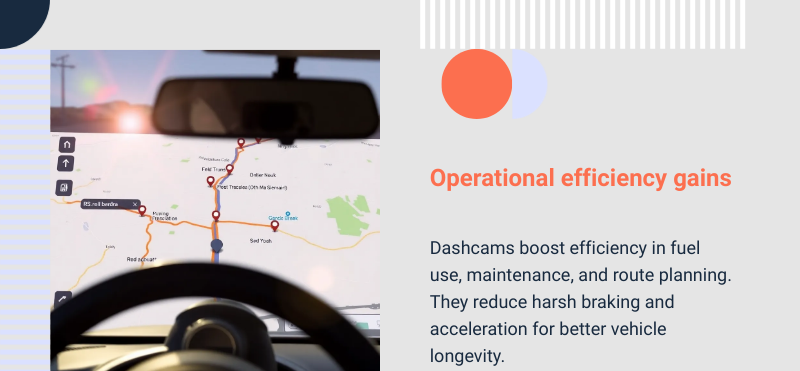
Operational efficiency gains must be included in TCO
Operational improvements driven by dashcams directly affect fuel usage, maintenance cycles, and route efficiency.
Areas of measurable efficiency improvement
- Reduced harsh braking and acceleration
- Lower fuel consumption
- Fewer unnecessary idle periods
- Improved route discipline
Improved driving behavior extends vehicle lifespan and reduces maintenance-related costs while also improving fuel efficiency .
Quantifying efficiency gains
Efficiency gains are typically calculated through:
- Fuel cost reduction per mile
- Maintenance cost reduction per vehicle
- Downtime reduction (hours or days saved per incident)
Even marginal improvements across a large fleet compound into substantial cost savings over time.
Claims and litigation avoidance redefine long-term ownership cost
Claims and litigation costs represent a disproportionate share of fleet financial exposure, making them central to any TCO model.
Dashcams provide:
- Verifiable evidence of incidents
- Protection against fraudulent claims
- Faster dispute resolution
In some cases, fleets have reduced accident-related losses significantly by preventing even a small number of incidents annually. A modest reduction in accident frequency can result in six-figure savings depending on fleet size and incident severity .
Key financial impacts
- Lower legal fees
- Reduced settlement payouts
- Decreased administrative overhead
- Shorter claim resolution timelines
These savings must be modeled explicitly rather than treated as intangible benefits.
Hidden costs that distort TCO calculations if ignored
Incomplete TCO models often fail because they ignore hidden or secondary cost factors.
Commonly overlooked costs
- Poor-quality hardware failures
- Data storage overages
- System downtime
- Driver resistance and retraining costs
- Integration challenges with existing systems
Low-cost dashcams may introduce higher long-term expenses due to reliability issues and insufficient functionality, increasing overall ownership costs despite lower upfront pricing .
Impact on decision-making
Ignoring these factors results in:
- Underestimated lifecycle cost
- Overestimated ROI
- Misaligned vendor selection
A complete TCO model accounts for both visible and hidden costs across the full lifecycle.
Comparing low-cost vs advanced dashcam systems in TCO terms
Upfront cost differences between basic and advanced systems often mask significant long-term financial divergence.
| Evaluation Factor | Basic Dashcam | Advanced AI Dashcam |
| Initial cost | Low | Higher |
| Subscription | Minimal or none | Required |
| Risk reduction capability | Limited | High |
| Evidence quality | Basic | High-resolution, multi-angle |
| Driver coaching | None | Real-time + analytics |
| Long-term savings potential | Low | High |
Basic systems function primarily as recording devices. Advanced systems operate as active risk management tools, generating measurable cost reductions across multiple categories.
The correct evaluation is not cost per unit, but cost per avoided incident.
Step-by-step framework to calculate fleet dashcam TCO
A structured approach ensures consistency and accuracy across the calculation.
Step 1: Define the time horizon
Use a 3–5 year window to capture full lifecycle impact.
Step 2: Calculate total costs
Include all acquisition, implementation, operating, and maintenance costs.
Step 3: Establish baseline metrics
Document pre-deployment metrics:
- Accident frequency
- Insurance premiums
- Fuel consumption
- Maintenance costs
Step 4: Estimate performance improvements
Use conservative assumptions based on operational expectations.
Step 5: Calculate annual savings
Include:
- Reduced accident costs
- Insurance savings
- Fuel and maintenance improvements
- Administrative time savings
Step 6: Apply the TCO formula
Net TCO = Total Costs – Total Savings
Step 7: Evaluate payback period
Payback Period = Initial Investment ÷ Annual Savings
Many fleets achieve payback within months when risk reduction is significant .

KPI tracking is required to validate TCO assumptions
TCO is not static. It must be continuously validated through performance metrics.
Core KPIs to monitor
- Accident rate per 100,000 miles
- Cost per claim
- Insurance premium trends
- Fuel cost per mile
- Maintenance cost per vehicle
- Driver safety score trends
Tracking these metrics over time ensures that expected savings are realized and sustained.
When dashcam TCO becomes negative (profitable)
Dashcam TCO becomes negative when total savings exceed total costs over the evaluation period.
This typically occurs when:
- Accident frequency decreases materially
- Insurance costs decline
- Operational efficiency improves consistently
- Fraudulent claims are eliminated
At this point, dashcams transition from cost center to profit driver.
Fleets that reach this stage treat video systems as core infrastructure rather than optional technology.
Common mistakes that invalidate TCO calculations
Errors in methodology lead to inaccurate conclusions and poor investment decisions.
Most frequent mistakes
- Focusing only on hardware cost
- Ignoring insurance and liability impact
- Using overly optimistic assumptions
- Failing to track baseline metrics
- Excluding indirect operational benefits
- Underestimating incident-related costs
Each of these errors systematically understates the value of dashcam systems.
FAQ: Total Cost of Ownership for Fleet Dashcams
How do you calculate TCO for fleet dashcams?
TCO is calculated by subtracting total cost savings from total lifecycle costs, including hardware, operations, maintenance, and risk reduction benefits.
What is the biggest cost factor affected by dashcams?
Accident-related costs and insurance exposure represent the largest financial impact.
How long does it take to see ROI from dashcams?
Many fleets see measurable returns within months, depending on incident reduction and insurance savings.
Are subscription fees significant in TCO?
Subscription fees are a meaningful cost component but are often offset by operational and risk-related savings.
Do basic dashcams provide the same TCO benefits?
Basic systems provide limited financial impact compared to advanced systems with analytics and real-time monitoring.
How do dashcams reduce insurance costs?
Dashcams lower risk by reducing accidents and providing evidence, leading to lower premiums and faster claims resolution.
What metrics should fleets track for TCO?
Accident rates, insurance costs, fuel usage, maintenance costs, and claim frequency are critical metrics.