
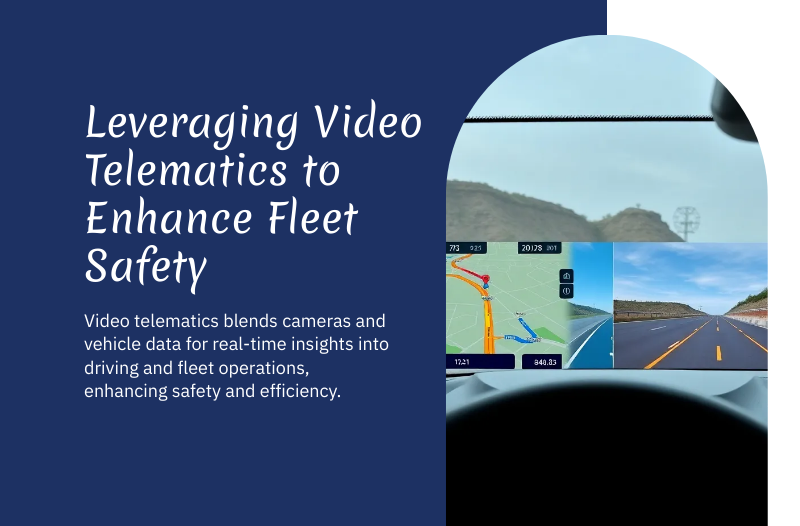
Video telematics is a technology that combines onboard video cameras with vehicle telematics data—such as GPS, speed, and sensor outputs—to deliver real-time, contextual insights into driver behavior and fleet operations. It goes beyond traditional telematics by capturing visual evidence of driving events and merging that with analytical data, giving fleet safety professionals a comprehensive, actionable view of what’s happening on and around the vehicle.
What Video Telematics Is and Why It Matters
Video telematics integrates dashcam footage with telematics sensors and software to record driver behavior, vehicle performance, and road conditions simultaneously. Unlike traditional telematics systems that provide numerical data points such as speed or location, video telematics adds visual context to those data streams. This visual layer makes it possible to understand not just that an event occurred, but why and how it happened—critical for safety analysis, coaching, and liability management.
Core components of a video telematics system typically include:
- In-cab and road-facing cameras that capture driver actions and external conditions
- Telematics sensors that collect vehicle status signals such as acceleration, braking, and GPS
- AI-driven analytics that detect risky behavior and generate alerts
- Cloud-based platforms for storage, review, and reporting
This integration creates a safety intelligence framework that drives measurable improvements in fleet performance.
How Video Telematics Transforms Driver Safety
Enhancing Real-Time Awareness
Video telematics systems detect unsafe driving behaviors such as distracted driving, harsh braking, or tailgating and flag them immediately. Drivers and fleet managers receive alerts in near real time, enabling corrective action before minor errors escalate into serious incidents. Real-time feedback strengthens accountability and reinforces safe driving habits through immediate behavioral correction.
Key real-time safety functions include:
- Distraction and fatigue detection
- Forward collision and lane departure alerts
- Speed threshold and following-distance notifications
These capabilities shift safety management from reactive review to proactive prevention.
Contextualizing Risk with Video Evidence
Traditional telematics might record an event like hard braking, but video telematics provides the surrounding context. Visual footage tied to sensor data clarifies whether the driver was avoiding a hazard, reacting to another motorist, or contributing to risk. This eliminates speculation during incident investigations.
Operational advantages of contextual footage include:
- Accurate reconstruction of events
- Objective liability assessment
- Reduction in fraudulent or inflated claims
The clarity improves both coaching outcomes and legal defensibility.
Strengthening Driver Coaching and Performance
Synchronized video and telematics data allows safety managers to conduct evidence-based coaching. Instead of abstract metrics, discussions center on observable behavior captured in real situations. This increases credibility and effectiveness.
A structured coaching process often includes:
- Reviewing flagged events with drivers
- Setting measurable performance goals
- Recognizing consistent safe driving behaviors
This feedback loop fosters sustained behavioral improvement and strengthens fleet safety culture.
Strategic Safety Outcomes Driven by Video Telematics
Reducing Accident Frequency
Video telematics reduces collision rates by identifying and correcting high-risk behaviors early. Continuous monitoring and feedback promote safer driving patterns across the fleet. Over time, safety violations decline as drivers internalize corrective guidance.
Lowering Liability Exposure
Documented visual evidence reduces ambiguity in crash investigations. Insurance claims resolve more efficiently when factual video data supports the fleet’s position. Reduced legal uncertainty translates into stronger risk management.
Improving Compliance and Operational Oversight
Video telematics supports regulatory compliance by maintaining time-stamped, audit-ready records. It also identifies operational inefficiencies such as excessive idling or aggressive acceleration that contribute to maintenance costs and safety concerns. Improved operational discipline indirectly strengthens safety performance.
Comparing Traditional Telematics and Video-Enabled Systems
| Feature | Traditional Telematics | Video Telematics |
| Driver Metrics | Speed, braking, idle time | Same metrics plus visual evidence |
| Incident Analysis | Data logs only | Data combined with video context |
| Real-Time Alerts | Sensor-based alerts | AI-driven, behavior-aware alerts |
| Coaching Effectiveness | Data review | Visual and data-based coaching |
| Liability Defense | Limited contextual proof | Objective, recorded evidence |
Video telematics enhances every traditional telematics capability by adding clarity and accountability.
Implementation Considerations for Fleet Leaders
Establish Measurable Safety Objectives
Successful deployment begins with defined outcomes such as reducing preventable accidents, improving driver safety scores, or lowering claims costs. Clear objectives guide configuration, reporting priorities, and performance measurement.
Develop Transparent Data Policies
Driver trust is essential. Organizations must clearly outline how video is used, who can access it, and how long it is retained. Emphasizing safety improvement over surveillance supports adoption.
Integrate with Existing Fleet Infrastructure
Video telematics systems should connect seamlessly with fleet management software, dispatch platforms, and maintenance tracking tools. Integrated systems provide a unified operational view and prevent data silos.
Prioritize Actionable Analytics
Large volumes of video data require intelligent filtering. Automated event detection and prioritization ensure that safety managers focus on meaningful risk indicators rather than routine driving footage.
Which safety indicators matter when video telematics is used as a prevention system?
Leading indicators drive measurable safety change because leading indicators show controllable behavior before crashes occur. Lagging indicators such as collisions and claims still matter, but lagging indicators arrive too late to shape day-to-day coaching priorities.
A practical KPI stack separates exposure, risk, and outcomes:
- Exposure: miles, engine hours, route types, time-of-day mix
- Risk signals: distraction events, following-distance violations, hard-braking clusters, speeding severity bands
- Outcome signals: preventable collisions, near-miss rate, claim cycle time, litigation rate
A useful rule is to weight coaching decisions toward high-severity, repeatable patterns rather than one-off events. One severe event with clean context can justify intervention, but most sustained gains come from reducing repeat behaviors over multiple weeks.
Safety scorecards work best when they are explainable
A scorecard motivates behavior only when drivers can connect scores to specific clips and clear standards. Black-box scoring increases resistance and leads to “gaming the metric” rather than improving driving.
Scorecards should emphasize a small number of behaviors that map directly to crash causation and defensibility. When too many categories exist, coaching becomes inconsistent and the program becomes a compliance exercise instead of a safety system.
How video telematics should be operationalized after an event occurs
An event-response workflow is the difference between “having cameras” and “running a safety program.” Event queues must be triaged quickly, but not every clip deserves equal attention.
A strong workflow uses three lanes:
- Lane 1: Immediate intervention (high severity, high confidence, repeat driver)
- Lane 2: Coaching queue (moderate severity, pattern-based, coaching-ready context)
- Lane 3: Documentation only (low severity or exonerating context that still benefits claims)
Escalation criteria should be explicit so managers do not improvise based on personality or pressure. When escalation is inconsistent, drivers perceive unfairness, and the safety program loses credibility.
Clip review must distinguish “avoidable risk” from “defensive driving”
Not all harsh braking is unsafe, and not all speeding is reckless. The visual layer should be used to classify the event into one of three categories: driver-caused, driver-contributed, or driver-avoided.
This classification improves coaching quality and reduces the common failure mode where safe drivers feel punished for reacting to hazards created by others.
What privacy and governance controls make a video telematics program defensible?
A defensible program is policy-driven, access-controlled, and consistent in application. Privacy failures are rarely about the camera itself; they come from unclear purpose, uncontrolled access, and ambiguous retention.
Minimum governance controls should include:
- Purpose limitation: safety, coaching, incident documentation, and compliance only
- Role-based access: reviewers, claims, legal, and safety leadership separated by permission
- Retention discipline: short default retention with longer retention only for triggered events or claims
- Driver visibility: drivers can view their own clips tied to coaching actions
- Tamper resistance: secure upload, audit logs, and documented chain-of-custody for evidentiary clips
- Clear boundaries: prohibitions on “gotcha” monitoring and micromanagement
Governance becomes easier when video telematics is framed as an incident-reduction and exoneration tool, not an always-on surveillance program. The operational posture should be “review when the system flags risk,” not “watch drivers.”
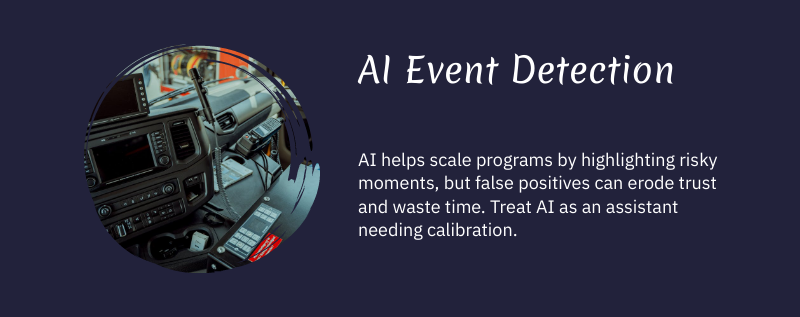
Where AI event detection helps and where it can undermine trust
AI increases program scalability by surfacing high-risk moments without requiring constant human monitoring. AI also creates a new failure mode: false positives that feel arbitrary to drivers and waste manager time.
AI event detection should be treated as an assistant with calibration, not an authority. Accuracy improves when thresholds are tuned to vehicle class, duty cycle, and roadway mix.
High-confidence detections tend to be the safest starting point for coaching: seatbelt compliance, phone use, stop-sign behavior, and forward-collision proximity patterns. Lower-confidence detections (such as nuanced distraction or ambiguous following distance in dense traffic) often require careful review before coaching is issued.
What operational risks increase during rollout, and how are they controlled?
Rollouts fail most often because expectations are unclear, coaching is inconsistent, or the organization tries to extract “perfect behavior” immediately. The first 60–90 days should be treated as a stabilization period focused on policy adherence and coaching quality rather than punitive enforcement.
Risk matrix: common failure modes and controls
| Risk | What it looks like in practice | Likely impact | Control that works |
| Driver resistance | “Cameras are for punishment” narrative spreads | Adoption failure, turnover | Publish a safety purpose statement and coaching standards; recognize safe performance |
| Reviewer inconsistency | Similar events lead to different outcomes | Perceived unfairness, grievances | Triage rules, reviewer training, and audit sampling |
| Data overload | Managers cannot keep up with events | Coaching stalls, program becomes performative | Severity thresholds, event bundling, and pattern-based coaching |
| False positives | Drivers get coached for defensive actions | Trust collapse | Require visual confirmation for coaching; tune thresholds by vehicle type |
| Poor evidence handling | Missing clips, unclear retention | Claim and litigation exposure | Retention policy, audit logs, and chain-of-custody process |
| Misaligned incentives | Scorecards become a disciplinary tool | Underreporting, gaming metrics | Separate coaching from compensation decisions; focus on improvement trajectories |
A rollout is successful when the program is predictable, drivers understand how events are interpreted, and managers can sustain the workload without heroics.
How to evaluate vendors when fleet safety outcomes are the goal
A vendor selection process should start with operational constraints, not feature lists. The right system is the system that can be used consistently by real safety teams with limited time.
Evaluation block: safety-first requirements
- Edge processing vs cloud reliance: event capture should not fail in low-connectivity zones
- Retrieval speed: claims and coaching depend on fast access to clips
- Event explainability: detections must be reviewable and coachable, not opaque
- Configurable triggers: thresholds by vehicle class and route profile
- Security and auditability: access logs, retention controls, and permissioning
- Coaching workflow support: annotation, assignment, acknowledgment, and follow-up tracking
A pilot should be judged on coaching throughput and driver acceptance as much as on detection volume. Systems that generate many events without improving coaching quality usually increase administrative burden without reducing risk.
What mature fleets do differently with video telematics
Mature fleets treat video telematics as part of a broader risk system that includes hiring standards, training, maintenance discipline, and incident governance. The technology becomes a consistent feedback loop rather than a periodic compliance tool.
The strongest programs build a closed loop: detect → classify → coach → verify improvement → recognize safe behavior → refine thresholds. That loop creates durable safety gains without relying on constant enforcement.
Addressing Common Misconceptions
Video Telematics Is Only for Large Fleets
The safety and liability benefits apply at any scale. Smaller fleets often experience significant ROI because a single major incident can disproportionately affect operations.
It Functions Solely as Surveillance
When deployed responsibly, video telematics operates as a safety and coaching tool. Clear policies and performance recognition frameworks position the system as a driver support mechanism.
Costs Outweigh Benefits
Preventing even one serious collision can offset hardware and implementation costs. Insurance savings and operational efficiency gains further strengthen financial justification.
Operational Risks and Mitigation Strategies
Potential challenges should be addressed deliberately:
- Driver resistance: Mitigate through communication and training.
- Data overload: Implement AI-driven event prioritization.
- Integration complexity: Select interoperable platforms and phase implementation.
Proactive planning ensures that safety enhancements do not introduce operational friction.
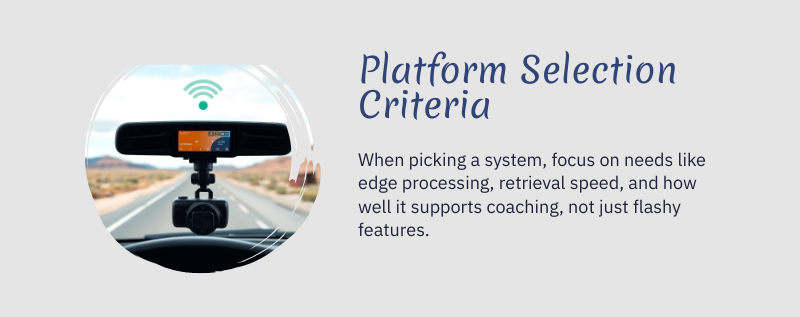
Criteria for Selecting a Video Telematics Platform
Evaluation should focus on:
- Camera resolution and low-light capability
- Accuracy of AI event detection
- Secure data storage and retention controls
- System scalability
- Vendor onboarding and training support
A disciplined selection process aligns technology capability with operational safety goals.
Fleet Video Telematics – People Also Ask (FAQ)
What behaviors can video telematics detect?
Video telematics detects distracted driving, fatigue, aggressive maneuvers, following distance violations, and compliance-related behaviors by analyzing combined video and sensor data.
How does video telematics improve insurance outcomes?
Objective video evidence accelerates claims resolution and reduces disputed liability, which can improve insurer confidence and risk assessments.
Is real-time alerting necessary for safety impact?
Immediate feedback significantly improves driver behavior because corrections occur at the moment of risk rather than after review.
How long is video footage typically retained?
Retention policies vary by organization and regulation but are typically configured according to compliance requirements and internal risk policies.
Can video telematics integrate with maintenance systems?
Yes. Integration allows fleets to correlate driving behavior with vehicle wear patterns and maintenance scheduling.
Does video telematics require constant monitoring?
No. Intelligent event-triggered recording and AI filtering reduce the need for manual review of routine footage.
What industries benefit most?
Logistics, construction, field services, passenger transport, and any safety-sensitive operation benefit from enhanced risk visibility.