
A recent Supreme Court ruling means freight brokers may face negligent hiring claims when they select a carrier involved in a serious crash. For motor carriers — especially smaller fleets relying on brokered freight — this is reshaping how brokers evaluate safety records, documentation, and risk before assigning loads. A carrier's safety profile may now directly influence load opportunities.
The Supreme Court Ruling Does Not Create Automatic Broker Liability

The ruling allows negligent hiring claims to proceed — it does not establish automatic broker liability or override federal carrier safety regulation.
The Supreme Court held that the Federal Aviation Administration Authorization Act's safety exception can allow certain negligent hiring claims because states retain authority over safety with respect to motor vehicles. The case was reversed and remanded — meaning the claim was sent back for further proceedings rather than resolved as a final liability judgment.
That distinction matters. A broker can still defend its carrier selection process. A plaintiff still has to prove the elements of the claim. The ruling does not erase federal regulation, create strict liability, or establish that every carrier crash automatically exposes a broker to damages.
Freight Brokers May Rely More Heavily on Safety Data
Historically, freight broker decisions have often been shaped by rate competitiveness and available capacity. A lower-cost carrier helps protect margin. However, a low rate becomes less attractive when a carrier's safety profile creates avoidable exposure after a serious accident. A more cautious broker may now ask:
- Is the carrier authorized to operate?
- Does the carrier have an unsatisfactory safety rating?
- Are there recent inspection or out-of-service concerns?
- Does the carrier have reportable crashes in its history?
- Is insurance active and appropriate for the freight?
- Can the carrier explain prior incidents with documentation?
- Does the carrier use safety technology to support claims defense?
These questions do not mean brokers will reject every carrier with a crash, violation, or inspection issue. A reportable crash may appear in a safety system even when the commercial driver was not responsible. A roadside violation may have been corrected quickly. The carriers that can explain their records with evidence will be better positioned than carriers that cannot.
FMCSA Data May Shape How Carriers Are Evaluated
The FMCSA Safety Measurement System can display information including U.S. DOT number, number of vehicles and drivers, inspections, BASIC categories, crash history, out-of-service information, and enforcement activity. That information can be useful — but it must be interpreted carefully. FMCSA's own SMS language warns that readers should not draw conclusions about a carrier's overall safety condition based only on displayed data unless the carrier has an unsatisfactory safety rating or has been ordered to stop operating.
A broker may see a crash in a carrier's history without any indication of whether the carrier's driver was at fault. A broker may see inspection activity without context about corrective action or driver retraining. Carriers should assume brokers may review this information — and be prepared to respond.
A Practical Safety Profile Review Should Include
- Operating authority and registration status
- Safety rating
- Out-of-service rates
- Driver and vehicle inspection history
- Reportable crash history
- Enforcement cases
- Insurance and licensing records
Crash History Can Hurt a Carrier Even When Context Is Missing
A carrier may be involved in a crash caused by another driver — a passenger vehicle cutting off a truck, stopping suddenly, or drifting into a lane. Without clear evidence, the carrier may still have to explain why the crash appears in its history. That is where documentation becomes essential.
Without Documentation
- Broker may assume fault without investigation
- Insurer focuses on frequency and severity alone
- Shipper sees only undifferentiated risk
- Plaintiff's attorney argues warning signs were ignored
- Carrier loses control of the narrative
With Dashcam Documentation
- Video shows road conditions and vehicle positioning
- Driver behavior before impact is clearly visible
- GPS confirms location, speed, and route
- Event footage gives carriers a defensible record
- Claims and broker questions can be answered quickly
Crash files, driver statements, police reports, maintenance records, GPS data, and video footage can help a carrier provide context. The stronger the documentation, the easier it is to respond to questions from brokers, insurers, and claims representatives.
Insurance Pressure May Increase Safety Scrutiny

If brokers face tougher underwriting, they may become more selective. Carriers with organized documentation and active safety technology are better positioned to remain on preferred carrier lists.
The industry reaction to the Supreme Court ruling included concern that litigation, due-diligence, and insurance costs may rise for brokers. Even without the most extreme predictions, the business direction is clear. Brokers may want more confidence that a carrier can be defended as a safe choice. Insurers may want to know how brokers screen carriers. Shippers may ask whether brokers have stronger risk controls in place.
That pressure reaches carriers quickly. If brokers face tougher underwriting, they may become more selective. If insurers view unresolved crashes as higher risk, carriers may face more questions during renewals. Safety technology does not eliminate liability — but connected video, GPS tracking, and driver monitoring help carriers show they are actively managing risk rather than reacting after a problem occurs.
Dashcam Evidence Helps Carriers Protect Their Reputation
A carrier's reputation is not based only on whether an incident occurred. It is also shaped by how clearly the carrier can explain what happened. AI dashcams and connected fleet camera systems can support carriers in several ways:
- Documenting accident circumstances with objective video
- Showing driver behavior before and after an event
- Supporting insurance and claims discussions
- Identifying risky driving habits before crashes occur
- Helping safety managers coach drivers proactively
- Reducing uncertainty in disputed incidents
- Demonstrating active risk management to brokers
Carrier Safety Reputation Depends on More Than One Score

Safety scores are a starting point. Brokers and insurers may look at the broader risk picture — including what documentation a carrier can actually produce when asked.
| Evaluation Area | Why It Matters | What Carriers Should Maintain |
|---|---|---|
| Operating authority | Confirms eligibility to operate | Accurate registration and active authority |
| Insurance status | Shows financial protection is in place | Current certificates and renewal records |
| Crash history | Indicates possible claims exposure | Crash files, reports, video, and preventability notes |
| Inspection record | Reflects roadside compliance | Inspection responses and repair documentation |
| Driver qualification | Supports hiring and retention standards | Driver files, MVR checks, and training records |
| Safety technology | Shows active risk management | Dashcam, GPS, and telematics records |
| Claims response | Affects broker and insurer confidence | Incident procedures and evidence retention |
The goal is not to create the appearance of a perfect fleet. The goal is to create a defensible safety record. Transportation carries unavoidable risk, and even responsible carriers can be involved in accidents. What matters is whether the carrier can show that the fleet operates responsibly, responds quickly, and documents safety-related events.
Carriers Should Review Their Safety Profile Before Brokers Do
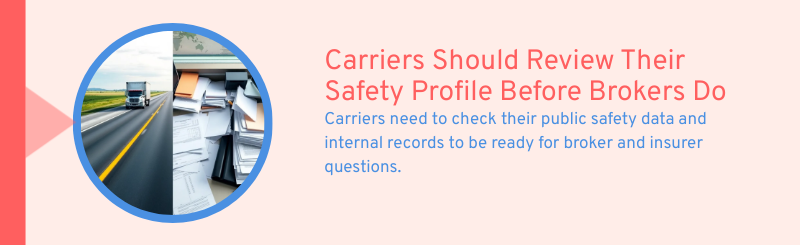
A carrier that waits for a broker to raise concerns is already responding from a weaker position. Preparation before the question is asked is where safety reputation is actually built.
A carrier that waits for a broker to raise concerns is already reacting from a weaker position. Safety reputation is not built at the moment a broker asks a question — it is built through preparation before the question is asked.
Know What Public Data Shows
Check operating authority, registration details, safety rating, inspection history, crash information, and enforcement activity. Any inaccurate or outdated information should be reviewed through the appropriate process.
Organize Internal Records
Be able to locate crash files, dashcam footage, driver qualification records, maintenance documentation, inspection responses, and insurance certificates quickly. Disorganized records create doubt even when the underlying safety issue is manageable.
Prepare Clear Explanations for Any Concern
If a crash appears in a carrier's history, know whether video evidence exists. If violations appear in inspection history, know what corrective action was taken. If a broker asks about safety controls, explain the systems without delay.
Frequently Asked Questions
Can freight brokers now be sued for hiring unsafe carriers?
Yes. Certain state-law negligent hiring claims against freight brokers may proceed when a broker is accused of selecting an unsafe motor carrier. The ruling does not automatically make brokers liable after every carrier accident.
Does the ruling directly affect motor carriers?
Yes. The ruling directly addresses broker liability, but carriers may feel the effect because brokers may review safety records more carefully before assigning freight.
Will brokers stop using smaller carriers?
Not necessarily. Smaller carriers can remain competitive if they maintain active authority, proper insurance, organized documentation, and a defensible safety profile.
Why does FMCSA data matter to brokers?
FMCSA data gives brokers a public view of carrier safety and operating information. Brokers may use that information as one part of a broader carrier vetting process.
Can dashcam footage help if the truck driver was not at fault?
Yes. Dashcam footage can help show what happened before, during, and after a crash. Video evidence may clarify disputed events and support claims defense when the carrier's driver was not responsible.
Should carriers review their safety records now?
Yes. Carriers should review public data, crash files, inspection history, insurance documentation, and available video evidence before brokers or insurers ask for details.
Is Safe Drive only useful after an accident?
No. Safe Drive dashcam solutions support driver coaching, event monitoring, GPS visibility, claims response, and long-term safety documentation — all of which build a stronger carrier profile before any incident occurs.
Give Your Fleet a Defensible Safety Record
AI dashcams, GPS tracking, cloud storage, and driver coaching — with no contracts and a free lifetime warranty.