
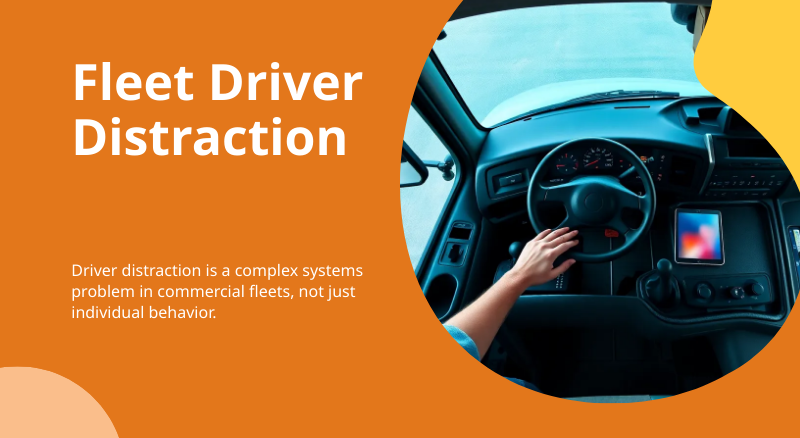
Driver distraction remains a systemic risk in commercial fleet operations
Driver distraction persists because it is not solely a behavioral issue — it is an operational, technological, and organizational systems problem. Commercial fleets operate in environments where cognitive load is structurally high, timelines are compressed, and digital tools compete for driver attention.
Even in fleets with formal safety programs, distraction re-emerges when production pressure, in-cab technology, and human cognitive limits intersect. Addressing it requires more than policy enforcement; it requires structural intervention.
Strategically deployed commercial dashcams with AI-based driver monitoring add an enforcement and feedback layer that helps operationalize safety policy in real time rather than relying solely on post-incident review.
For fleet safety managers, operations leaders, and driver coaches, the issue is not awareness. It is execution consistency under real-world constraints.
Cognitive overload is the underlying mechanism behind most distraction events
Distraction is often framed as a momentary lapse. In reality, it is frequently the result of cognitive overload.
Commercial driving demands:
- Continuous hazard scanning
- Route navigation
- Mirror and blind-spot monitoring
- Compliance with traffic laws
- Monitoring vehicle performance
- Radio and dispatch communications
When additional stimuli are layered into this environment — device alerts, telematics notifications, incoming messages, passenger interactions, or fatigue — attention fragments.
Cognitive science distinguishes between three forms of distraction:
| Type of Distraction | Description | Fleet Example |
| Visual | Eyes off road | Reading a device screen |
| Manual | Hands off wheel | Adjusting in-cab hardware |
| Cognitive | Mind off driving | Thinking about scheduling pressure |
The most dangerous form in fleets is cognitive distraction. A driver may appear attentive while mentally processing route confusion, delivery delays, or personal stress.
Coaching must therefore address mental bandwidth, not just device usage.
In-cab technology unintentionally increases distraction risk
Technology intended to improve safety can introduce competing stimuli.
Modern commercial vehicles may include:
- GPS dashcam navigation systems
- Electronic logging devices (ELDs)
- Telematics tablets
- Dispatch communication platforms
- Forward-facing camera alerts
- Collision mitigation systems
Each system generates prompts, alerts, or data streams. Without structured configuration, drivers experience alert fatigue.
Alert fatigue leads to three predictable outcomes:
- Ignored warnings
- Delayed reactions
- Manual interaction while in motion
Fleet leaders often underestimate the cumulative effect of overlapping systems. Technology governance — not just technology adoption — determines whether tools reduce or amplify distraction.
Production pressure creates invisible cognitive distraction
Schedule compression directly contributes to unsafe attentional tradeoffs.
When drivers perceive delivery deadlines as rigid and unforgiving, they engage in compensatory behaviors:
- Multi-tasking while driving
- Route recalculation on the move
- Texting dispatch at traffic lights
- Mentally rehearsing schedule recovery
This behavior is not rooted in recklessness. It stems from perceived performance expectations.
Operations leaders must examine whether:
- Delivery windows are realistic
- Performance metrics incentivize speed over safety
- Dispatch communication protocols are clearly defined
Distraction frequently reflects organizational culture rather than individual indiscipline.
Mobile device policies fail when enforcement lacks behavioral reinforcement
Most fleets maintain formal policies prohibiting handheld device use. However, policy documentation does not eliminate risk.
Policy breakdown occurs when:
- Violations are inconsistently addressed
- Supervisors model unsafe behavior
- Drivers do not perceive monitoring credibility
- Enforcement focuses only on severe incidents
Effective programs integrate:
- Clear progressive discipline
- Real-time detection tools
- Positive reinforcement for safe behavior
- Transparent communication about monitoring
Policy without reinforcement becomes symbolic.
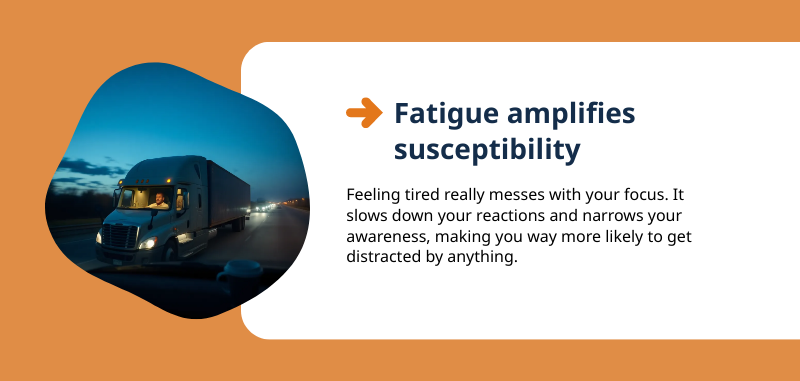
Fatigue amplifies susceptibility to distraction
Fatigue reduces working memory capacity and reaction speed, increasing vulnerability to distraction stimuli.
In fatigued states:
- Drivers shift attention more slowly
- Peripheral awareness narrows
- Decision-making becomes reactive
- Risk perception declines
Even minor secondary tasks become cognitively demanding.
Fatigue-related distraction often presents as:
- Missed exits
- Delayed braking
- Lane drift without device involvement
Fleet safety strategy must treat fatigue management and distraction mitigation as interdependent.
Driver familiarity with routes can increase complacency
Experience reduces conscious attention allocation.
When drivers repeatedly travel the same routes, attentional resources free up. While this increases efficiency, it also invites:
- Mind wandering
- Device checking during predictable stretches
- Reduced active hazard scanning
Familiarity-induced distraction is particularly dangerous in urban routes where variability is high despite perceived predictability.
Coaching should reinforce deliberate scanning behaviors even on routine routes.
Video telematics exposes patterns that traditional reporting misses
Incident-based reporting captures outcomes. Video telematics captures precursors.
In-cab and forward-facing cameras identify:
- Phone handling behaviors
- Long glances away from roadway
- Delayed hazard recognition
- Risk escalation sequences
This data allows fleets to intervene before collisions occur.
Leading vs Lagging Indicators in Distraction Management
| Indicator Type | Example | Strategic Value |
| Lagging | Collision caused by device use | Post-incident analysis |
| Leading | Repeated 2+ second glances at screen | Preventive coaching trigger |
Fleets relying only on crash reports react too late. Preventive analytics reduces systemic exposure.
Coaching effectiveness determines long-term behavior change
Distraction reduction requires sustained coaching — not one-time training.
High-performing programs share common traits:
- Event-based coaching within 72 hours
- Driver self-review of video footage
- Non-punitive first-response approach
- Documented follow-up sessions
- Behavior tracking over time
Drivers respond better to data-driven, specific feedback than generalized warnings.
Coaching must shift from “do not use phones” to “here is your 3.4-second glance event and its potential outcome.”
Specificity drives accountability.
Fleet leadership alignment directly impacts distraction outcomes
When executive messaging emphasizes productivity without equal safety reinforcement, drivers interpret priorities accordingly.
Operational alignment requires:
- Safety metrics weighted in performance reviews
- Executive visibility in safety meetings
- Dispatch accountability for communication timing
- Budget allocation for monitoring technology
Distraction persists when safety is operationally secondary.
Executives set the behavioral ceiling for the organization.
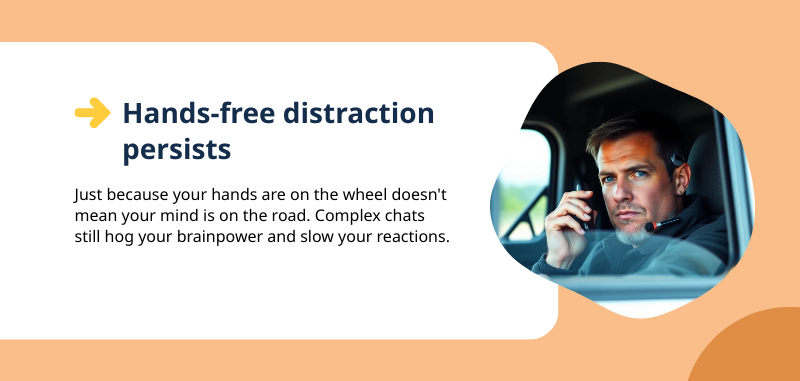
Hands-free does not eliminate cognitive distraction
Hands-free policies reduce manual and visual distraction but do not eliminate cognitive diversion.
During complex phone conversations:
- Reaction time slows
- Situational awareness decreases
- Hazard anticipation declines
Cognitive load increases when drivers engage in emotionally charged discussions or detailed problem-solving calls.
Fleet policies should limit non-essential calls during active driving, even if hands-free compliant.
Compliance does not equal safety.
Risk amplification occurs during transitional driving moments
Distraction incidents frequently cluster around transitions:
- Lane merges
- Construction zones
- Urban intersections
- Weather shifts
- Route deviations
These moments demand peak attentional resources. Secondary task engagement during transitions disproportionately increases crash probability.
Fleet training should emphasize “zero-task tolerance” during transitions.
A structured distraction mitigation framework reduces systemic exposure
Sustainable distraction reduction requires an integrated framework.
Core Components of a Distraction Control System
- Technology governance and alert consolidation
- Clear communication timing protocols
- Fatigue management integration
- Video-based coaching programs
- Cultural alignment between safety and productivity
- Real-time behavior monitoring
- Executive oversight of safety KPIs
Each element addresses a different causal pathway.
Fragmented approaches fail because distraction is multi-factorial.
Measuring distraction requires behavioral metrics, not assumptions
Quantifying distraction requires observable indicators.
Effective measurement includes:
- Duration of eyes-off-road events
- Frequency of manual device interaction
- Rate of distracted driving alerts per 1,000 miles
- Coaching completion rates
- Recurrence within 30–90 day intervals
Metrics must differentiate between isolated and habitual behaviors.
Data clarity enables targeted intervention rather than blanket retraining.
Dispatch communications can be engineered to reduce distraction without slowing operations
Dispatching is a frequent trigger because it blends urgency with ambiguity. A message that reads “Call ASAP” forces a driver to choose between response speed and road focus, even when the actual issue could wait.
A safer operational design treats driver attention as a protected resource. Communication protocols should define when messages are sent, how they are labeled, and what qualifies as truly time-critical.
Dispatch standards that reliably reduce in-motion interaction:
- Use preset status codes instead of free-text back-and-forth for routine updates
- Require “pull-over to respond” language for any message that needs typing
- Establish quiet windows during merges, construction corridors, and dense urban segments
- Separate navigation changes from performance feedback or coaching notes
- Limit escalations to voice-only, with the expectation the driver will return the call when stopped
- Set a maximum message length to prevent scrolling and rereads
These controls work because they remove interpretation pressure. Drivers should not be forced to decide whether a message is worth a glance.
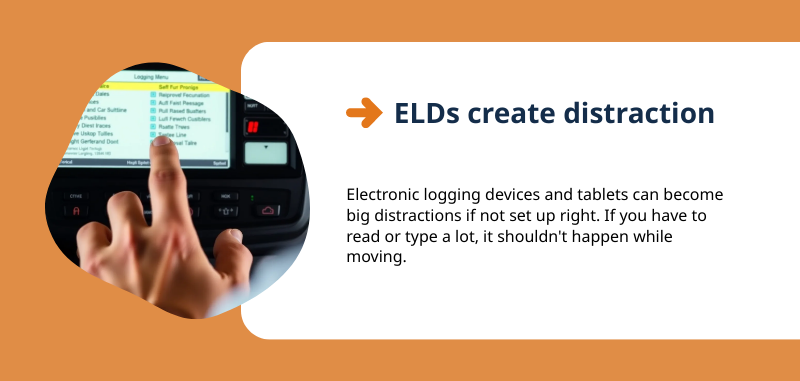
Device lockouts and interface design determine whether ELDs become a distraction vector
ELDs and driver tablets become distraction drivers when they are treated as general-purpose screens. Even when the intention is compliance, the interface can demand too much visual attention at the wrong time.
Fleets reduce risk by applying a simple principle: if a task requires reading, typing, or multi-step navigation, it should not be possible while the vehicle is moving. Lockouts are not a punishment; they are a guardrail that prevents “quick checks” from turning into long glances.
Cab ergonomics is a safety control, not a comfort feature
Mount placement, screen angle, and glare management shape glance duration. If the screen sits low, far right, or below the dash line, the driver’s eyes travel farther and remain off-road longer.
A practical standard is that any required display should be readable in a short glance without head rotation. If a driver must turn their head or refocus multiple times to interpret the screen, the cab setup is enabling distraction.
Hands-free driving remains a risk because cognitive distraction does not require a screen
Hands-free rules often create a false sense of closure. The problem is that attention can be consumed by conversation complexity, emotional content, or problem-solving demands even when both hands stay on the wheel.
Cognitive distraction tends to present as “late recognition” rather than obvious device handling. Drivers brake later, miss subtle cues, and become less proactive in anticipating what other motorists might do.
Calls that should be prohibited while driving
Some calls are predictably high-load and should be deferred until stopped. This is a decision criterion, not a moral stance.
| Call Type | Why It’s High Risk | Safer Alternative |
| Conflict resolution | Elevated emotion narrows attention | Stop, call back, document outcome |
| Detailed rerouting | Requires spatial reasoning and planning | Pre-approved reroute workflow |
| Disciplinary or performance calls | Triggers defensiveness and rumination | Schedule post-trip coaching |
| Complex customer coordination | Multi-step instructions invite note-taking | Use standardized delivery notes |
The goal is consistent decision-making. Drivers should not be improvising call safety rules in the moment.
“Eyes-off-road time” is the operational metric that matters most
Distraction management improves when the fleet measures behavior in concrete terms. The most actionable measure is not the number of messages sent or calls taken, but the duration and frequency of eyes-off-road events.
Long glances are more predictive of serious outcomes than brief checks. Fleets that coach glance behavior can reduce risk even before they eliminate every distraction source.
Structured evaluation block: how to set a practical threshold
Objective: reduce long-glance exposure without creating unworkable rules.
Recommended approach:
- Define a “high-risk glance” as any single eyes-off-road event long enough to miss a developing hazard sequence
- Prioritize coaching on repeated events, not one-off anomalies
- Separate “task-driven” glances (equipment, mirrors, instrument cluster) from “non-driving” glances (screens, objects, personal items)
- Track recurrence over 30–90 days to identify habit formation
Decision rule: treat repeated long-glance events as a coaching trigger and a system-design trigger. If multiple drivers show the same pattern, the environment is contributing.
Work-related distraction is often the hidden category fleets under-manage
Many distracted driving programs focus on personal phone use. In commercial fleets, the larger contributor is frequently work-related activity: dispatch messages, navigation changes, proof-of-delivery steps, and exception handling.
When the work requires constant micro-decisions, drivers try to “keep the day moving” by blending tasks. That behavior is rational inside a misaligned system.
Operations leadership can reduce work-driven distraction by shifting tasks earlier or later in the workflow. If a task must be done mid-route, it should be engineered for minimal interaction and predictable timing.
A risk matrix clarifies where distraction controls produce the most benefit
Distraction is not evenly distributed across driving contexts. Fleets reduce incidents faster when they focus controls on the highest-consequence combinations of speed, complexity, and task load.
| Context | Common Trigger | Risk Level | Control Priority |
| Highway at speed | Message glance or call | High | Lockouts, quiet windows, coaching |
| Urban intersections | Navigation adjustments | High | Pre-route planning, simplified cues |
| Work zones | Curiosity glance, stress | Very High | Zero-task tolerance, strict policy |
| Yard/terminal | Device setup | Medium | Pre-departure checklist, mounting standards |
| Stop-and-go traffic | “Quick reply” temptation | High | Pull-over rule, no typing standard |
This matrix works because it directs behavior where consequences are largest. It also gives driver coaches a concrete framework for “when the rules tighten.”
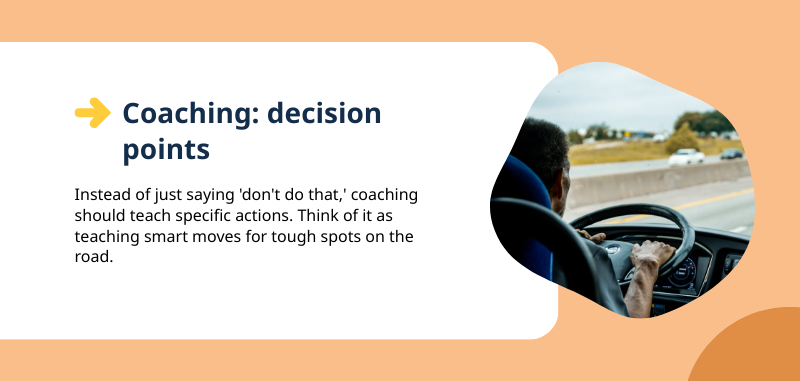
Coaching scripts should focus on decision points, not moral warnings
Drivers change behavior when the coaching conversation is specific, fair, and repeatable. Generic warnings about distraction rarely compete with real operational pressure.
A practical coaching approach is to train “decision points” the driver can repeat under stress:
- “If the vehicle is moving, the screen is not a task.”
- “If the message needs typing, the answer is stop.”
- “If the situation is complex, defer the call.”
- “If the route changes, accept the delay rather than multitask.”
Driver coaches should treat improvement as skill acquisition. The target is not perfection; it is fewer high-risk moments and fewer repeat events.
Sustainable reduction happens when the fleet removes incentives to multitask
Distraction persists when drivers believe that speed, responsiveness, and constant availability define good performance. That belief is reinforced through dispatch behavior, KPI design, and informal praise.
Operational alignment is the durable fix. When leadership signals that safe driving decisions are protected — and backs it with workload design and communication rules — drivers stop treating distraction as a necessary tradeoff.
Operational redesign reduces the need for in-motion multitasking
The most effective distraction mitigation strategy reduces drivers’ need to multitask while moving.
Operational redesign may include:
- Pre-shift route briefing
- Device lockout while vehicle in motion
- Standardized dispatch windows
- Automated status updates
- Reduced mid-route rerouting
When drivers are not required to manage logistics dynamically while driving, cognitive load decreases.
Systems shape behavior.
Driver Distraction in Commercial Fleets – People Also Ask
Why do commercial drivers still use phones while driving?
Commercial drivers use phones while driving primarily due to schedule pressure, dispatch communication demands, and normalized multitasking behaviors.
Is hands-free driving safe for fleet vehicles?
Hands-free use reduces manual distraction but does not eliminate cognitive distraction, particularly during complex conversations.
How can fleets detect distracted driving?
Fleets detect distraction through video telematics systems that monitor eye movement, device handling, and unsafe glance durations.
Does driver training eliminate distraction risk?
Training alone does not eliminate risk. Ongoing coaching, monitoring, and cultural alignment are required.
What is the biggest cause of distraction in commercial fleets?
The largest contributors are cognitive overload, in-cab technology alerts, and operational production pressure.
How does fatigue relate to distracted driving?
Fatigue lowers cognitive capacity, increasing susceptibility to attention shifts and delayed hazard recognition.