
Why a 10-year platform delivers sustained operational value
A 10-year dashcam platform creates compounding operational advantages, while a gadget delivers isolated, short-lived functionality. The distinction determines whether a fleet evolves or remains reactive.
Fleet environments require consistency across vehicles, drivers, and time horizons measured in years—not months. A system must persist long enough to standardize behavior, accumulate data, and integrate into daily workflows without constant replacement or reconfiguration.
A platform assumes continuity. It is built to remain in place, improve over time, and become embedded in how the business operates.
A gadget assumes disposability. It performs a function, then gets replaced.
What separates a gadget from a fleet-grade system
A gadget is a standalone device that captures footage without contributing to broader operational outcomes. It lacks the infrastructure required to support fleet-wide visibility or decision-making.
These devices typically share the same limitations:
- Footage stored locally on SD cards
- Manual retrieval and review processes
- No centralized system for oversight
- Limited durability in commercial environments
- No integration with operational or safety workflows
- No upgrade path beyond replacement
The result is fragmented visibility. Each vehicle becomes its own isolated data point, disconnected from the broader fleet.
This approach creates operational blind spots rather than eliminating them.
What a platform architecture actually enables at scale
A platform transforms video capture into an operational system that supports safety, compliance, and performance management across the entire fleet.
It is defined by what happens after an event occurs—not just the recording itself.
A properly designed platform enables:
- Centralized, cloud-based video access
- Real-time event detection and alerting
- Standardized driver safety scoring
- Continuous coaching workflows
- Fleet-wide visibility across all vehicles
- Structured data retention and retrieval
- Integration with telematics and operational tools
This creates a unified system where every vehicle contributes to a single source of truth.
Over time, the platform becomes part of the company’s infrastructure—not an add-on.
Why lifecycle cost favors platforms over short-term devices
A platform reduces long-term cost by eliminating inefficiencies that are invisible at the point of purchase. The difference is not in upfront pricing—it is in total operational impact.
Short-term devices introduce hidden costs that accumulate:
- Frequent hardware replacement due to failure
- Labor required to manually retrieve footage
- Missed incidents due to storage gaps
- Inconsistent data across vehicles
- Increased liability exposure
- Lack of automation in safety workflows
These costs are not one-time events. They repeat across vehicles and over time.
Cost Comparison: Gadget vs Platform
| Factor | Gadget Approach | Platform Approach |
| Hardware lifespan | Short, inconsistent | Long-term, commercial-grade |
| Data access | Manual | Instant, cloud-based |
| Labor requirement | High | Reduced through automation |
| Scalability | Limited | Designed for expansion |
| Risk exposure | Reactive | Proactively managed |
| Upgrade path | Replace device | Software-driven evolution |
The longer the system remains in place, the more the platform compounds value while the gadget compounds cost.
Why data—not video—is the true long-term asset
Video captures events. Data transforms them into operational intelligence.
A gadget produces isolated footage that must be manually interpreted. A platform converts that footage into structured insights that can be acted on immediately.
Over time, this distinction becomes critical.
A platform enables fleets to:
- Identify recurring driver behaviors
- Detect patterns across vehicles and routes
- Prioritize high-risk drivers for coaching
- Track safety improvements over time
- Build defensible records for insurance and legal use
Without structured data, video remains passive. With structured data, it becomes a continuous feedback system.
This is where long-term value is created.
How reliability determines long-term system viability
Fleet technology must operate continuously under demanding conditions. Reliability is not a feature—it is a requirement.
Consumer-grade devices are not engineered for:
- Constant vehicle vibration
- Extreme temperature fluctuations
- Daily operational usage
- Long-term uptime expectations
Failure in these environments is predictable, not exceptional.
A platform-grade system is designed differently. It assumes continuous operation across years, not occasional use. It minimizes downtime, reduces maintenance requirements, and ensures consistent data capture.
Reliability is what allows a system to remain in place long enough to generate meaningful value.
Without it, no long-term strategy is possible.
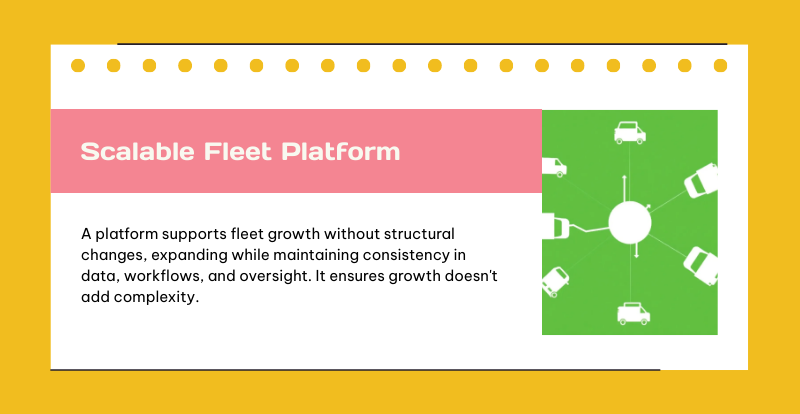
What scalability looks like in a platform-driven fleet
A platform supports growth without requiring structural changes. It expands with the fleet while maintaining consistency in data, workflows, and oversight.
This allows organizations to:
- Add vehicles without introducing new systems
- Maintain uniform safety standards across locations
- Monitor performance at both local and global levels
- Scale coaching programs without increasing administrative burden
A gadget-based approach breaks under scale.
Each additional vehicle introduces more fragmentation, more manual work, and more inconsistency. There is no central system to unify operations.
A platform removes this friction. It ensures that growth does not introduce complexity.
How SafeDriveDashcam.com aligns with a platform-first strategy
SafeDriveDashcam.com is structured as a long-term fleet platform rather than a standalone device solution. Its design reflects the operational realities of commercial fleets.
The system is built around continuous use, centralized visibility, and long-term deployment rather than short-term functionality.
Key characteristics include:
- Cloud-connected video access across the fleet
- Real-time event detection and notification
- Centralized management for all vehicles
- Driver behavior monitoring and coaching support
- Scalable architecture for fleet expansion
- Hardware designed for commercial durability
The emphasis is not on the camera itself, but on the system it supports.
This distinction allows fleets to move beyond incident recording into active risk management and performance improvement.
What operational risks arise from relying on gadgets
A gadget introduces structural risk because it cannot support consistent oversight or timely intervention.
These risks often remain hidden until an incident occurs.
Common Risk Exposure Areas
- Missed critical footage due to overwritten or corrupted storage
- Delayed incident response caused by manual retrieval processes
- Inconsistent driver monitoring across vehicles
- Lack of defensible records in legal or insurance scenarios
- Inability to identify behavior trends across the fleet
- Fragmented data that cannot be analyzed collectively
These are not edge cases. They are systemic limitations.
A platform mitigates these risks by standardizing how data is captured, stored, and used.
Why continuous improvement depends on system continuity
Safety and performance improvements require time, consistency, and feedback loops. A system that is replaced every few years cannot support meaningful long-term change.
A platform enables:
- Longitudinal tracking of driver performance
- Measurable improvements in safety metrics
- Iterative refinement of coaching programs
- Alignment between policy and behavior
This creates a feedback cycle where the system becomes more valuable the longer it is used.
A gadget interrupts this cycle. Each replacement resets progress and fragments historical data.
Continuity is what enables improvement.
What decision-makers should evaluate before choosing a system
The decision should be based on long-term operational impact rather than immediate functionality. The right system will influence safety, cost, and scalability for years.
Core Evaluation Criteria
- Does the system provide centralized fleet visibility?
- Can it scale without introducing complexity?
- Is data structured and actionable, not just recorded?
- Does it reduce manual processes and labor requirements?
- Is the hardware built for continuous commercial use?
- Does it support long-term deployment without replacement cycles?
These criteria determine whether the system will function as infrastructure or remain a tool.
Where short-term thinking breaks down in fleet technology
Short-term thinking prioritizes initial cost and immediate functionality over long-term impact. This leads to decisions that appear efficient but create structural inefficiencies.
The breakdown occurs in three areas:
Operational Fragmentation
Different vehicles operate with different systems, creating inconsistent data and oversight.
Data Loss Over Time
Historical information is lost or inaccessible, preventing long-term analysis.
Escalating Labor Requirements
Manual processes increase as the fleet grows, reducing efficiency and increasing cost.
These outcomes are predictable when systems are not designed for longevity.
People Also Ask
What is the difference between a dash cam and a fleet platform?
A dash cam records video, while a fleet platform captures, analyzes, and distributes data across the organization for operational use.
Why are consumer dash cams not suitable for fleets?
They lack centralized management, durability, and integration capabilities required for commercial-scale operations.
How long should a fleet dash cam system last?
A properly designed system should support continuous operation and value creation over a multi-year horizon, typically approaching a decade.
What makes a dash cam system scalable?
Centralized data management, cloud connectivity, and consistent workflows across vehicles enable scalability.
How do platforms reduce liability risk?
They provide immediate access to verified footage, structured data, and consistent records that support faster and more defensible claims handling.
Is cloud storage necessary for fleet dash cams?
Cloud storage enables instant access, centralized management, and long-term data retention without manual intervention.
What role does driver monitoring play in fleet safety?
Driver monitoring identifies risky behaviors, enabling targeted coaching and measurable safety improvements over time.
Long-term infrastructure decisions define fleet outcomes
Fleet technology decisions determine whether operations remain reactive or become systematically optimized. Systems built for continuity create compounding advantages that extend beyond safety into efficiency, cost control, and organizational visibility.
The distinction is not between devices—it is between short-term tools and long-term infrastructure.